


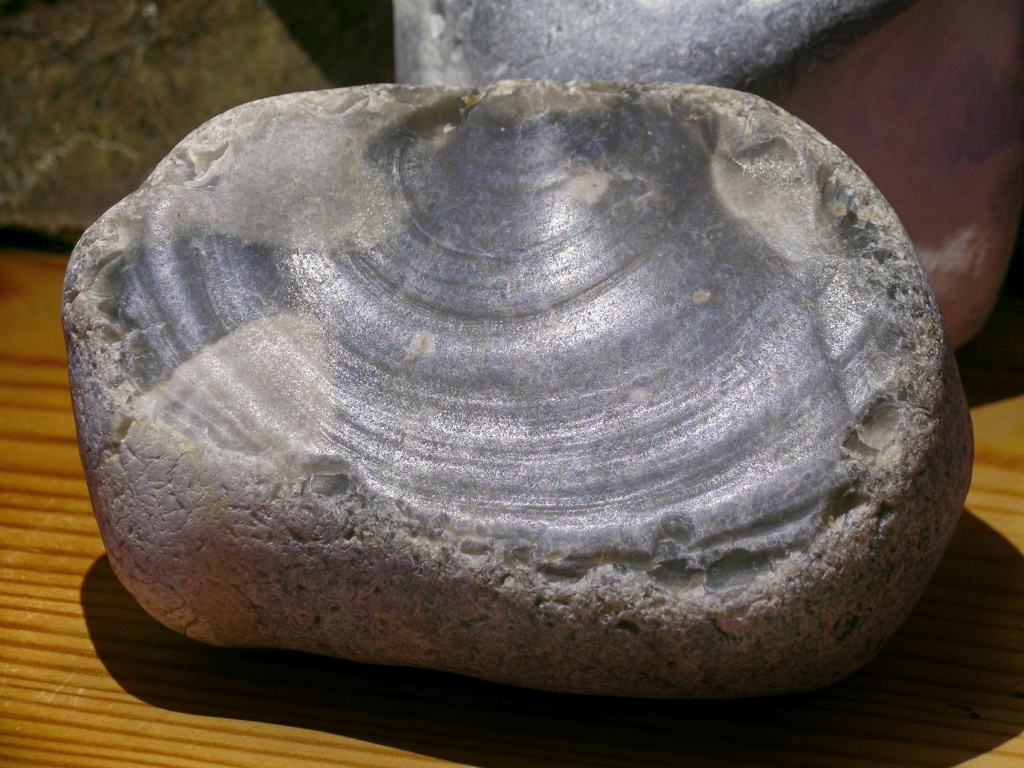
Large Example of a Conchoidal Fracture in a Flint Pebble
Conchoidal Fractures are quite familiar in flint and other very hard and brittle stones. They look very much like the growth banding of a shell, hence the name. They are a visual expression of the shockwave that travels through it from the impact that causes the fracture, the so-called 'bulb of percussion', which radiates out until a portion of rock sheers off. They are extremely common among flint pebbles, but this is one of the biggest I have ever seen, at 9cm across the fracture face. Obviously, this is not something that can be cut and polished - it's a stone to be enjoyed as-is. 9cm
|


Countries:
USA - Canada - Alaska - Mexico - Argentina - Peru - France - Germany - UK - Poland - Greece - Turkey - Romania - Bulgaria - Slovakia - Kazakhstan - Uzbekistan - Russia - Japan - Ethiopia - Iran - Australia - Unknown